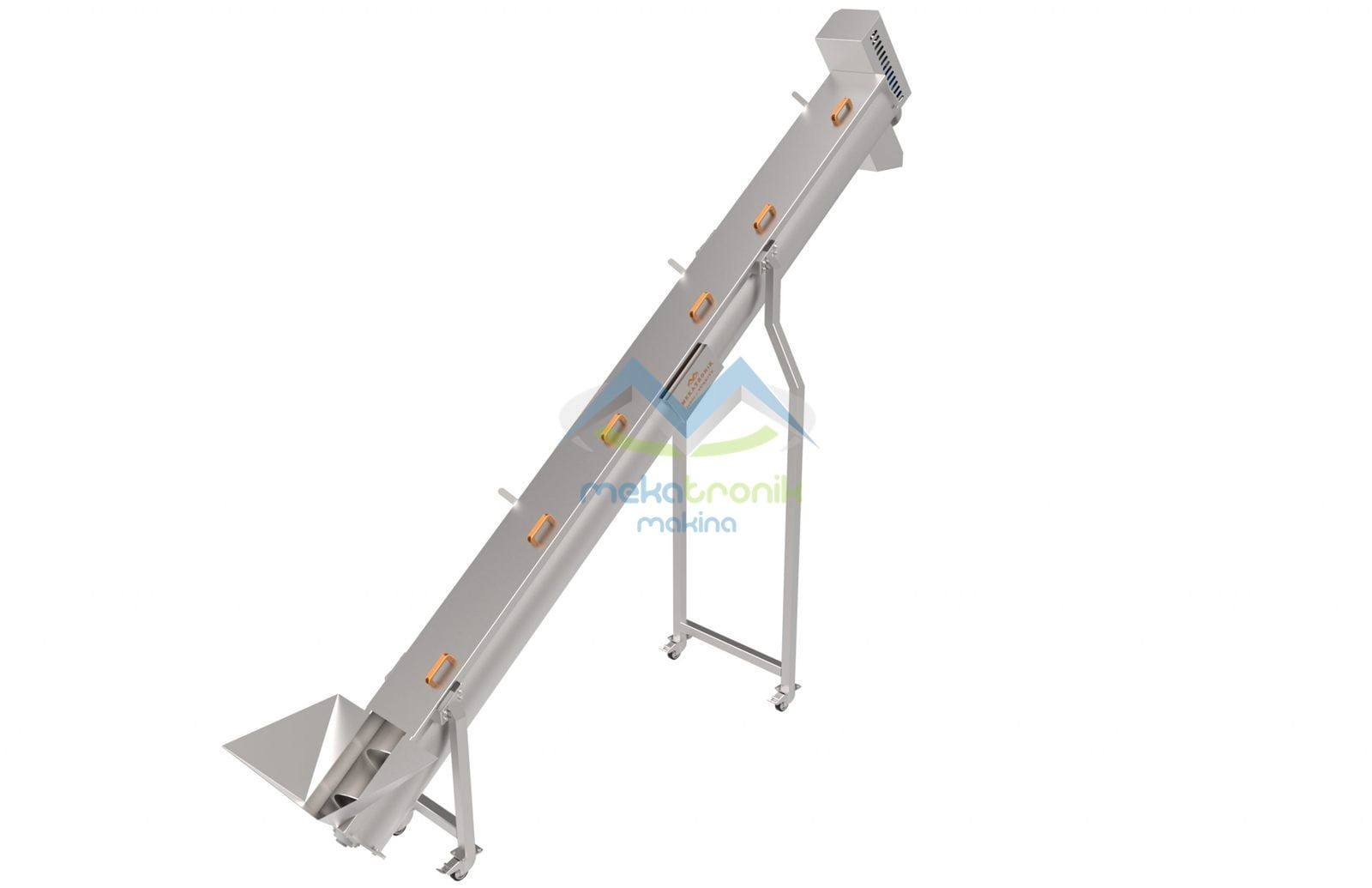
Two settings decide how a feeding screw conveyor treats the product: rotation speed and cleaning routine. If the speed does not suit the product, the screw either starves the line or pushes product forward by crushing it. If the cleaning routine is not in place, residue builds up in the housing and carries over into the next batch. This article covers how to approach speed and cleaning for a screw conveyor on a food line.
01
How does the screw move the product?
The Feeding Screw Conveyor takes product from its trough and delivers it to the next stage with a screw turning inside a closed housing. A geared motor turns the screw, and each turn advances the product by a certain amount. Because the housing is closed, the product is protected from outside, but for the same reason what happens inside cannot be seen. That is why speed and cleaning need to be thought through in advance.
Product does not behave the same everywhere. A sticky product such as raisins clings to the screw flight and the housing wall, while a free-flowing product moves on easily. The same screw should not be expected to run at the same speed for two different products.
02
What is rotation speed set by?
On this machine, speed control is left to the user through geared motor options, and the rotation speed is set to suit the product. Quoting an exact figure would not be right: the value depends on the product, the capacity and the station behind it, and is set with the real product during commissioning.
When setting speed, look at:
- 01Product stickiness: sticky product can build up on the flight at low speed and be squeezed and crushed at very high speed.
- 02How full the trough is kept: an empty trough means the screw turns with little product, an overfilled one makes product jam.
- 03The take-up rate of the station behind: if the screw delivers faster than the next equipment accepts, product piles up.
- 04Control type: with PLC control the speed follows the line, while in independent operation the operator sets it.
Speed is not a value to set once and forget. It needs another look whenever the product type or moisture changes.
03
How do the top covers make cleaning easier?
The top covers fitted as standard serve both safety and cleaning. Because they open, the inside of the screw and trough can be reached and residue cleaned where it can be seen. Since the screw must not turn with a cover open, cleaning is done after the machine is stopped and de-energised.
Residue collects most at the ends where the screw shaft is supported, at the joint between trough and housing, and at the corners where product changes direction. Checking these points at a product changeover or at the end of a shift prevents carry-over into the next batch. The housing is AISI 304 stainless steel, and the motor and electrical equipment must be protected during washing.
| What is observed | Likely cause | Where to look |
|---|---|---|
| Product crushed in the screw | Speed too high or trough overfilled | Rotation speed and feeding pattern |
| Station behind runs short | Speed too low or build-up on the flight | Speed setting and inside the screw |
| Previous batch appears | Residue not cleaned | Ends, joints and corners |
| Cleaning takes long | Covers are hard to reach | Position of the machine in the line |
04
How are capacity and control decided?
The capacity of the Feeding Screw Conveyor is defined per project, and control can be set up either with a PLC or as independent operation. If the line is tied to other equipment, PLC control makes it easier to keep the screw speed in step with the station behind. At a stand-alone feeding point, operator setting may be enough. Which one suits is settled at the quote stage by looking at the line as a whole.
Custom dimensions built for the place and purpose of use are also possible. Trough length, screw length and discharge height are chosen according to where the receiving equipment sits. If the drop between the screw outlet and the receiving equipment grows, product strikes the surface, so it helps to place the outlet close above the receiving equipment. It is sounder to evaluate these choices together on the project drawing than to make them without measuring on site.
05
How do the castor feet affect placement in the line?
The Feeding Screw Conveyor stands on lockable castor feet, so it can be moved around the facility. Mobility helps with cleaning too: once the machine is pulled away from the wall and neighbouring equipment, the covers open freely. In working position the castors must be locked, otherwise vibration moves the machine and the connection to the hopper or conveyor is disturbed.
To see which screw suits which line, you can browse the Stainless Screw Conveyors category.
06
Next step
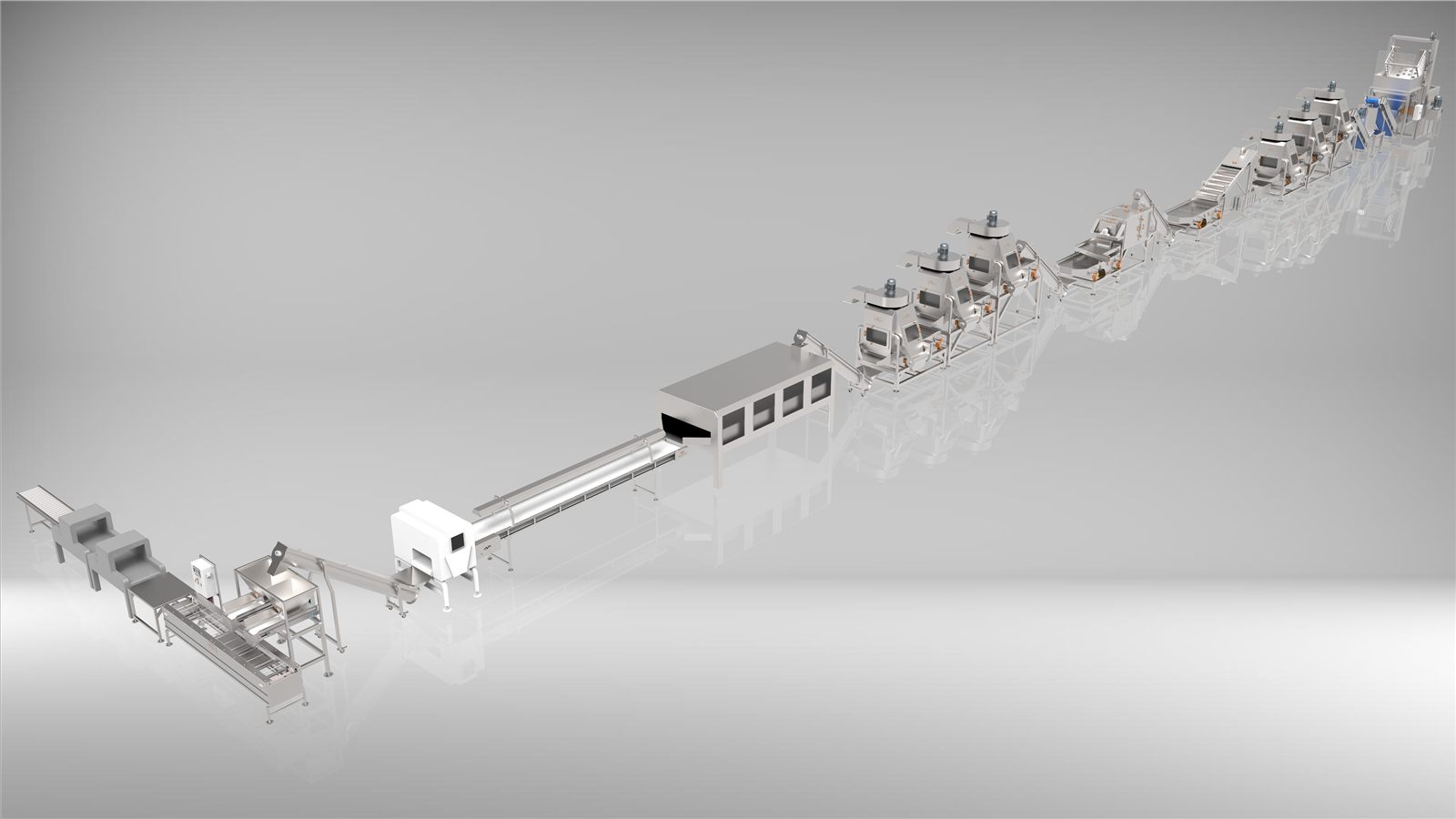
To set up speed and cleaning together for your product, you can reach us through the quote page, or see the line where the screw conveyor is used on the Raisin Processing Line page.